Friday, July 03, 2009
The Panama Canal - Part 1 of 2
The transit of the Niki Wiki:
Because we were crossing from the Pacific Ocean to the Atlantic/Caribbean Sea (northward, yes, really – look at a map), we were scheduled for departure in the morning with the expectation that we would be out of the last lock by 5 or 6pm on the same day. Pleasure boats coming the other way (southward) leave in the evenings and spend the night on Gatun Lake in the center of the isthmus of Panama. They then continue their journeys the next day.
Jonesy had gotten up at the crack of dawn to dinghy over to the pier and pick up our hired line-handler, Sal, who was the teenage son of our driver Federico. We were standing-by the VHF radio and ready to go at 7:30am as instructed. Our rented long lines (120 feet) were c
oiled on deck, 18 used tires were hanging along our sides as bumpers, Mexican sleeping floor pads were secured over our solar panels, food was packed in every available space onboard, and our nerves were tingling.Okay – let’s go! We left the anchorage at La Playita and motored past the Balboa Yacht Club moorings towards the first lock – Miraflores lock. Waited again. There are 3 locks up to the center Gatun lake and 3 locks down. Finally, we were instructed to follow a tugboat into the lock and to toss our starboard lines to the port side of the tug. Fine.
osed behind us and the water started to rise. Fast. Soon we were level with the next section of the canal, the front gates opened. After separating ourselves from the tug we motored out. Whew! Only 5 more locks to go.
f our line-handlers was to snatch up the monkey fist, tie it to our long lines and signal the canal worker. The worker then pulls up both lines, and slips the large loop that we’ve tied in our line, over a bollard (a big metal stump) on top of the wall. Then as we rise in the water, our line-handlers continually take in the slack in the line. See on the top of the wall? That's a worker adjusting two of our lines from the starboard side of the boat.As he tried to re-toss the monkey fist, we drifted farther and farther away from his side of the canal and he just couldn’t get the fist to go the distance. Eventually, we drifted right up against the rough canal walls, but didn’t hit it because our trusty crew & Advisor went forward to hold our bow off of the wall.
Finally, the canal worker gave up. The canal authority closed the gates behind us and the worker walked across the tops of the gates, got the line, and walked it back to the correct side. There was a lot of friendly bantering going on the radio between our Advisor and the canal workers. The crew on this lock had just won the contest for mo
nkey fist tossing and now they were blowing it with us.But, it all worked out fine - the water came rushing in and we floated up to the top of the
walls. Next up is a 4 hour motor cruise across Gatun Lake at top speed - 8 knots. We are supposed to cross the lake and descend down the 3 locks on the other side to the Caribbean. Here's a photo of the "new" bridge (one of only 2 connecting North & South America) over the lake as we approached it.
nd spent a lot less money. It cost us $900 to go thru the canal with a $900 deposit for damage which we have already gotten back. Shipping your yacht from ocean to ocean runs about $15,000 and up.
This was the time of year when many cruise ships "reposition" from the Caribbean over to the Pacific Ocean for summer cruising up to Alaska.
Burro Kickstand?
Count the legs on this burro - 5? Naw, the "leg" on the left side of this photo is actually the Burro Kickstand. Yep. Drive your burro up to the delivery site, drop the kickstand and unload your bags of gravel. Actually, it's a good idea. The kickstand takes the weight of the cart off of the burro while the cart is stationary.This little guy was hauling loads of gravel for the new dock that is being built here at Club Natutico in Cartegena. I fed him a carrot and a couple of cubes of "panela" which is a delicious local minimally-processed sugar. Locals make hot and cold drinks from this sugar, and candies of all sorts, and put it in their coffee.
The guys in the photo are chuckling because I wanted to take this photo of a burro. Silly gringa.
Wednesday, July 01, 2009
The Boys
In April we had some very special guests - Our BOYS! Plus friends! We had all been planning this for a long time – coordinating our travels and their lives so that everyone could be here for the passage through the Panama Canal. We had to have 4 "line-handlers" plus a captain who drove the boat to go through the canal - so why not have our big strong kids? It’s so hard for them to get time away for work and to scrounge up the extra bucks for travel – but we love it when they do!So here we all are on the Amador Causeway outside of the anchorage in Panama City with the city in the background. From left to right that’s Jonesy, our oldest son Ryan, me, our younger son Brett, and friends Josh and Stephanie. Those tall buildings in the background are locally known as "Cocaine Towers" - buildings that drug money built and are largely unoccupied. I was told that they launder the cash by borrowing money (clean $) from the banks to build these condos, then pay back the bank with the drug (dirty) cash.
One of the best things about having guests is that it gets us out of our
routine. We go see the tourist attractions – not just the inside of boat yards and hardware stores. Everyone wanted to see some jungle wildlife so we hauled ourselves out of our bunks super early the next morning for an adventure. (Everyone except Jonesy – he wanted to do “boat chores” and I gave everyone the choice of jungle trip or boat chores. Which would you choose?)Our local driver – Federico, took us for the long ride out to a nature observation site on the world famous Pipeline Road. This area, in the interior of Panama, is known for the large number of species of birds. As we were crawling along the dirt road to the facility, we passed quite a few “birders”. Real “birders” – folks who are totally into bird watching. They had all the gear; high powered binoculars, cameras, jungle outfits, made me feel sorta ill-prepared with my entry-level binos and only 2 bird identification books.

Anyway, we paid our fees ($20 per person) and picked up our own personal guide. He led us to the observation tower in the jungle. Great! Where’s the elevator? Oh. Stairs. So we tramped up the winding staircase to the top.
What a view! Our guide had a high-powered scope and he would find the birds or monkeys and then let us all look at them.
We saw toucans, and, um…well…um…yellow birds and blue ones and woodpeckers and beautiful butterflies. I guess I should have had Ryan (our family bird expert) write them all down for me because I’ve forgotten what everything was called. At the visitor center there were
literally a hundred hummingbirds! We just hung out on the tower, scanning the tree tops, searching our bird books to identify what we could find and enjoying the view.Finally, we decided to go down to t
he jungle floor and walk over to a lake for more bird life. The Panama Canal and Gatun lake were close by.
Along the trail we spotted these 4” wide bare strips of earth. What were they? Looking closer we saw that they were ant trails! If you dropped a leaf in the way, the ants would quickly get together and move the leaf to the side, clearing the trail. Fascinating!
Right next to the “La Playita” (free) anchorage in Panama City, there is a Smithsonian Research Institute and a little visitor center ($2). We wandered around the grounds and saw a large nu
mber of iguanas in the trees. And – this sloth. He was just creeping along upside down along the arbor trellis. It wasn't a fence to keep him (her?) in at all - he's just wild and free. So, now I know…they are 3-toed sloths!Next blog will be about the Panama Canal transit!
Monday, June 22, 2009
From Boring to S#@! in 60 seconds
From a rather dull morning, we suddenly had a wild ride! A serious squall came up and many of the sailboats anchored out in the harbor started to drag their anchors and take walkabouts. Unfortunately, the marina was downwind from quite a few of these wanderers! The high winds drove a catamaran right up to the bow of our boat. We felt pretty helpless standing on the bow with the wind blowing and the waves crashing and this big boat moving towards us. Check out the mean-looking clouds beyond!
But as luck would have it, the catamaran's propellor got caught on one of our lines that is secured the the "heavy thing" on the bottom. This was actually a good thing. It held them about 3 feet away from us. And that's where they rode out the squall.
When it was safe, a diver went down, untangled them, and another boat towed them away out into the harbor to re-anchor. Whew! I had to stop knitting for about an hour...geeeez!
As for knitting...I whipped up another pair of socks for the Akkol Orphanage kids. These are knit from a combination of leftover commercial sock yarns (Opal and Regia) with a strand of a handspun single ply yarn held together. Years ago, I visited a hand-spinning guild up in northern California. There, I picked up for about $5, a baggie full of hand-spun single
s.I think that the ones I used for these socks were naturally colored - one was a very tightly spun wool, and the other was a another tightly spun alpaca (I think). Anyway, I like the combination and they turned out really soft. Okay...time to walk through town over to the shopping center. We need to make an exciting purchase...a new garden hose nozzle for our raw water washdown system. Does this gal know how to have fun or what?
Sunday, June 21, 2009
We're in the CLUB
Yep! We finally got into CLUB NAUTICO which is a small, somewhat scruffy marina here in Cartegena. We had spent about two weeks at anchor in the harbor, and riding in the dinghy to the marina, while we waited for a slot to open up for us. Now, we are living the good life...cable TV, wifi internet, running water (most of the time) and electricity.So, we are berthed right at the outside corner of a dogleg. This is a view of the planks we walk to get to the boat. It's a li
ttle rough out there so we gotta keep our eyes on our feet to make sure we don't fall down ('cause maybe we couldn't get up). The uneven surface is largely due to the planks that cross, and are tied to the dock, that are the boarding apparatus for other boats.Ah...here's the Niki Wiki safely tied to...what? Oh, some lines are tied to the pier, and others are tied to "something heavy" on the bottom of the harbor! A diver came out to take our long lines down and tie them off.
Now, because of the thunderstorms, high winds, and large chop from either winds or other vessels in the harbor we are a rocking and a rolling a lot of the time. So, we can't be tied up too close to this stationary pier/dock or we'll bang around and get damaged.Okay. Now how do we get on and off the boat when it is 6 feet away? Well, there is a little narrow "finger" that sticks out on one side of us. But we are about 3 feet from that. What to do?
Well, we tied a line to a bollard (big pole) on the finger and then wrapped it around a winch. When we want to get off of the boat, we crank in the line which moves the boat sideways closer to the
f
inger. Then, we climb up and over the lifelines, crab a couple of feet back to the stern, and stretch one foot down to a stair step on the finger.So far neither of us has fallen in the water! But, this situation perhaps limits the adult beverage consumption ashore. When the tide is higher, Niki Wiki floats higher and our legs just barely can span between the boat and the dock. Who needs yoga? We get our stretching exercises daily just because we live on this boat!
NOTICE: Jonesy is wearing his "Handsome Devil" Socks designed and knit by me in these photos and I didn't even ask him to wear them!

We've been getting out and about, exploring the historic Spanish city of Cartegena. Here's Jonesy on
top of the stone wall that was built to keep out the English pirates. The cannons are even still there.This is a view of a typical street in the old "centro" area of Cartegena. This is a functioning city with people working and living in these buildings. During the day, when it is hot, there are just a few people strolling about. But at night - whew! - the crowds come out! We're trying to get ourselves acclimated to the timing of life here. Dinner is not served until 7pm at the earliest. Even the tiny food places and street vendors don't open until that - or later.
WORLDWIDE KNIT IN PUBLIC DAY was Saturday June 13th. To celeb
rate, I registered an "event" here in Columbia at the Club Nautico marina. So, here I am, knitting in public. Where are all the other knitters? Jonesy kept saying that the big tour bus full of knitters would be arriving any moment. I knew that he as kidding...there just aren't any other knitters. I be it for this party.My project this day was another pair of wool (Cascade 220) mittens for the Akkol Orphanage in Kazakhstan. This time though I added a simple checked pattern to make the mittens warmer and to keep me awake.
also worked on a new pattern for another pair of mittens. Ripped it all out and started again. Repeat. Repeat. Okay. So I ripped this mitten out SEVEN times! It wasn't that the design is so difficult, it was just that I kept changing my mind, and hopefully improving, what I wanted to produce.Sunday, June 07, 2009
More Kuna Yala Photos
What can I say...the San Blas Islands of Panama (also known as the Kuna Yala) is beautiful. This dolphin was part of a group (pod? school?) who played alongside our boat as we moved between islands. He kept rolling over and looking up at me as I stood on the bow to take a picture of him. Here is is looking at me while I was looking at him.As you can see, the seas were calm and flat. No wind. Thus, no sailing that day. And here's a pic of Jonesy at the "helm" and one of a very rare sunset. We had steady sunsets when we were in Mexico, but the clouds and thunderstorms
obscured most of the sunsets in Panama for us. So this is quite unusual for the rainy season to have a sunset.
That's it for today - the cruiser's potluck/BBQ is starting in an hour and I must go marinate the chicken and whip up a dish to share. Haven't knit a stitch all day!Monday, June 01, 2009
Introducing...Isla Buena Socks
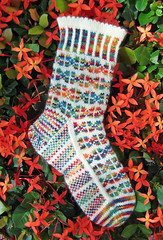
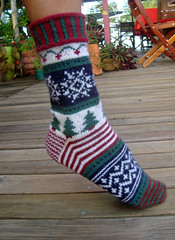
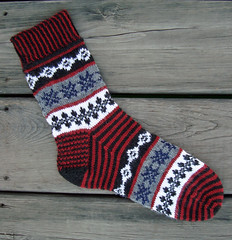
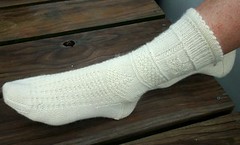
Ta da! Today is the official release of my new design - Isla Buena Socks as the June/July pattern for the Six Sox Knitalong yahoo group.This top-down knit sock features fair isle type patterning and a sideways garter stitch cuff. For the photo samples, I knit the Men's size in "manly" colors approved by Jonesy. The yarn is Regia 4-fadig sock yarn.
The brighter colored ver
sion below is also Regia 4-fadig sock yarn and is the Women's Medium size (you can tell because there are fewer repeats of the pattern around the leg and foot).Some of the group's test knitters knit their socks in great color combinations including a touch of varigated yarn for the snowflake patterning.
So...see? I haven't been a boat-vegetable all the time. I did actually produce something besides mindless knitting. The name, Isla Buena, is a loose translation of "Fair Isle" to Spanish which seemed fitting as I designed these in El Salvador and knit them in Nicaragua. Just a little tip of the hat to the countries that I visited.
Sunday, May 31, 2009
Hammock Time
What a change from last week to today! From the isolated back-to-nature scene of the Kuna Yala islands to the cosmopolitan life of the big city of Cartegena. This is the view I get each night now as I engage in "hammock time". It's still in the 80's at night, but there's a nice breeze which makes the hammock sway ever so slightly. This is where I knit in my head - work out patterns - mull over ideas, etc.Now, all I can sh
are with everybody is the knitting I've done for the Mittens for Akkol group for the children's orphanage in Kazakhstan. The other things I've been knitting have been designs are for the Holiday Mystery Gifts Knitalong which begi
ns again this September. So, if I showed those goodies here it wouldn't be a mystery now, would it? But smart folks may expect a couple of mitten patterns.Let's see...the grey ones are adult sized mittens knit from Cascade 220 wool with a heathered green set of stipes. The striped pair are adult mittens from
lots of different leftover yarns - Alpaca, Llama, Wool, and Icelandic (Lopi) Wool.These wild things are knit from an Opal yarn (Rodeo?) which is a sock weight yarn. You know, when I use these self-patterning yarns everyone is so amazed. I try to explain that all I'm doing is plain 'ole knitting and the yarn makes the design, but I don't think most non-knitters really understand.
So, besides reading a lot of mystery and trashy novels, I also knit 5 of those cotton diagonal dishcloths. Why? Well, that has to stay a mystery.
Wednesday, May 27, 2009
Kuna Yala
The tiny islands (400 of them!) of the Kuna Yala nation are along the eastern side of Panama in the Caribbean Sea. Although they are part of the country of Panama, they are self-governed by the Kuna tribal people. Of all the places that we've visited these past three years, this is our number one favorite spot!Warm, clear blue water, friendly local people, soft breezes, palm trees and white sand beaches. The coral reefs were so wild with sea life that we felt like we were in a slightly overdone theme park. Fresh fish were readily available and once a week a canoe would come by with fresh fruits, v
egetables, eggs, and beer from the mainland.
The tiny island of Nuinudup, in the Eastern Lemon Cays was where we anchored for a couple of weeks. While Jonesy soaked in the sea and monitored the adventures of several 10” starfish, I took a stroll to the little palm shack seen in the background of the photo – clear over on the other side of the island. Yep, that’s how small the island is – about a football field size. And yes, one of those boats in the background is our Niki Wiki. The two boats look the same don't they? Well, they are sister ships - both Gulfstar Sailmaster 50 feet - and there were only a handful (14? 17?) ever produced. Tropical Dance is the other ship.

The resident ladies had strung up their molas and were patiently waiting to make a sale from the anchored sailboats. Molas are the reverse-applique panels which are hand-sewn, and embroidered by the Kuna women. They wear these panels as part of their traditional dress. Men wear t-shirts and shorts.
Nowadays, the Kuna women sell some of the molas to raise cash. The other cash crop is the coconuts from the islands. These they sell to Columbia to make copra - for cosmetics and industrial use.

Each morning, we would see two women paddle to the island in a dugout canoe. Throughout the day, as we sat in the cockpit of our boat reading or knitting, we would see them washing clothes in the fresh water wells, picking up coconuts, and sitting in the hammocks sewing on new molas. When dusk fell, they would paddle back over to another nearby island (Banedup).
The women speak only Kuna – no Spanish and no English, unlike the men who learn Spanish in school. But through hand gestures I indicated t
hat I only had $3 with me, but that I was interested in their molas and photos. I offered my $3 for the privilege of taking photos which was quickly accepted. We understand that many of the Kuna people don’t like having their picture taken, but that a little cash sometimes provides access.So here is one of the women in her full Kuna costume which she wears every day. The top is a blouse of very lightweight fabric which has the mola sewn ont
o it around the waist. There are two mola panels used – one for the front and one for the back of the blouse. The skirt is simply a piece of printed fabric wrapped around and tucked in. Here is a closeup of her personal mola. This is a very traditional design – it has the maroon color
ed background and geometric striping of primary colors in many layers of fabric. All strips are hand-sewn in matching thread color and details are embroidered on in single ply threads.This is a photo of some of the modern molas she also had for sale. These are not traditional molas and some purists won’t even call them “molas”. They are made only for the tourist trade. The designs are appliquéd versus the traditional reverse layering process, and use larger pieces of fabric.

Here is a closeup of the strings of beads that adorn the women’s legs and arms. They are strung so that they create geometric designs as they are wrapped up the legs and arms.
So, the next day the ladies came to the boat in their dugout canoe to sell me some molas. In the Kuna households, it is the women who manage all the finances, and they are really good saleswomen!Because it was gently raining, I invited them onto the boat to look through their extensive stash of molas. We were able to enjoy looking at a full plastic pail (the usual luggage here in Kuna Yala) of molas. I picked out several that I liked (yes, I
got a couple of small touristy ones because I liked them – and they make great gift items) and we paid – with US dollars as that is the currency here. Yes, it used to be coconuts, but that was many years ago.Fortunately for us, and unfortunately for the Kuna economy, the prices of molas as dropped this past year or so. There are not as many tourists or cruisers coming through to buy molas. I cringe at the low pr
ices because I know how many hours of work go into each piece. We make sure that we buy some from every location that we visited. We feel that it is a payment for the use of their beautiful islands and waters.I'll get photos of my collection and post them later. I did manage to buy one each from two different "Master Mola Makers". The quality is magnificent in these two pieces and I cherish them. I also have a small set of the beads for a bracelet.
In a few months, we'll be heading back out to these beautiful islands. There is a community of cruisers who live full time out there and we made many friends.
Next blog: Knitting accomplishments...
Tuesday, May 26, 2009
We're in Cartegena Columbia!
What a wild month it has been and I've got lots to share...Panama Canal, knitting, and our time hanging out in the San Blas Islands of Panama - also known as the Kuna Yala.Of all the places we've visited in the prior three years of cruising, we vote this unique, remote spot on earth as the best stress-free cruising hang out. No swells to rock the boat, no loud music from hotels or restaurants (because there aren't any) and very few people. We spent many hours in the warm, clear waters, and explored just a handful of the 400 white sand islands with palm trees.
We'll write more and upload pictures in the next few days...first, check emails, then go shopping!
Friday, April 24, 2009
Shopping in Panama City
Panama City is a favored shopping destination for cruisers. Here, we can find all sorts of manufactured goods that we've done without, sometimes for years as in our case!A typical trip to the market, marine supply store, or even a mall, begins with a dinghy ride into the little harbor from where our boat is anchored. Then, depending on tide - which can be as much as 18 feet - there may be a steep climb up to the plaza. Here I am making the trek at low tide. At high tide, this ramp is almost horizontal.
Next, comes
a short walk out to the main street to pick up a bus (25 cents) or a taxi ($4) for a ride to the nearest stores. Along the way we may even spot a sloth up in a tree. Here's a photo of a mommy sloth with her baby dangling from her like a limp teddy bear. Look closely...that appendage is a head and a arm of the baby. Yep. These guys move really s-l-o-w-l-y if at all. I can't belive how slowly they move each limb.Once at the stores, you have to be careful about what you buy. Like SIP. Would you name a washing detergent "sip"? Especially when it comes in lime flavor/scent?

But for the most part, we actually recognize the brand names because they are the same as back in the states. What fun! It sure makes it easier to shop too. This was not the case in the other Central American countries - it as mostly local brands.
Over at the giant Albrook Mall we can walk all day and still not see it all. On a Saturday, the place is packed with families. The sounds of the carousel, which runs continuously, fills the halls of the mall. The cleanliness, bright lights and colors are a stark con
trast to the grimy concrete apartment buildings of the city.
Here, you can buy a tee-shirt with your favorite hero - Bob Marley or Obama? Yep, Obama is much admired throughout Panama and is one of the favorite topics of discussion from the taxi drivers or other local folks we meet.

Huh? What is up with the female mannequins? Really, these buxom babes are all over the mall. I just don't get it. These are used in the windows to display even conservative clothing. Some of the stores cover up the pointy areas. Maybe they were on sale at the mannequin store or something?

After a long day of being consumers again, we limp back to the little harbor and the dinghy dock. At the plaza above the dock there are often other cruisers hanging out and sometimes playing music. But, soon we need to f
ind our dinghy, scramble over allthe other dinghys, toss packages in and zoom out to the Niki Wiki.
Now...it's knitting time....
Friday, April 17, 2009
Too Many Bananas
There comes a time when you have to admit to having too many ripe bananas. Yep. That happened to us when we were cruising the Las Perlas islands. All the cute little red bananas ripened at the same time.What to do? Well, we had banana pudding, fried bananas with brown sugar and walnuts, banans muffins, bananas on our oatmeal, and the best? That would have to be the banana Daiquiri at sunset. Yummy! And because we'd been out cruising for so many days it
was time to make Jonesy some hot dog and hamburger buns. Sure wish I could eat wheat too.Cruising in Central America is a lot different from Mexico. There is a lot more wind and the anchorages are less populated and have far fewer facilities. And, there are much fewer boats in each anchorage. After spending over a week sailing and anchoring around the islands we quite simply got weary of the isolation.
The water temperatures hovered at 66 degrees (brrrrrr) which was far too cold for comfortable full-body immersion in addition to being somewhat murky, so we didn’t have swimming for a diversion. Although we still had fresh fruit (thanks Domingo!) and plenty of provisions (the lack thereof is what drives a lot of cruisers back to civilization), we decided it was time to travel on to Panama City.
How many books can you read, projects knit, or hours spent gazing at the island scenery before it all becomes unsatisfying? The answer for us is “Plenty”…but eventually we are maxed out on those simple pleasures and get restless for new adventures. The big lights and tall buildings of Panama City were calling us so we hoisted the anchor and took off. Okay, so a little of our edginess was over the upcoming transit through the Panama Canal – all the unknowns!

Because there was absolutely no wind, we motored over glassy seas towards Panama City and the canal. We weren’t the only ones. All over the area, huge freig
hters were also converging on the same small area. Our radar and chart plotter showed the swarm of other vessels – all moving in the same general direction as us but at significantly faster speeds (we were at 5 knots and they were traveling at up
to 20 knots!). This was particularly unnerving when they were approaching from behind us. Look out! We are a small, fragile little ship! Our chart plotter software with the new AIS system will identify those“boogies” that are on near-collision courses (2 miles or less) with us. The little triangle symbols flash. Yep, we had lots of flashing ship triangles on our screen.By 1pm we were in the controlled area of the canal and could see the high-rise buildings of the city in the distance. The bay is the staging area for all ships either planning to go through the canal or just emerging from the down-locks and traveling under the Bridge of the Americas. So, to manage all these vessels, there is a control tower just like at an airport.

We had to check in with the tower and ask permission to travel to the La Playita (free) anchorage for sailboats. Permission was granted and we motored over to the fleet of over 50 other boats. Whew- some other freighter crewman was in the wrong place and was getting a royal chewing-out by the controller! All marine radio communications are in English worldwide (as is air traffic) so we could understand what was being said.
With relief, we dropped the hook in La Playita within sight of the Panama Bay control tower (see photo on top of the little island. Wow, the little fleet here in th
e anchorage is totally international! We see flags on the boats from many different countries!Ah! Internet access finally. Yep. Just pick a table on the outdoor patio at the Bennigan's Grill & tavern which is walking distance from the boat (a hot, long walk carrying backpacks that we've lugged in the dinghy and fret over getting wet) No. That's the fancy-schmancy high-dollar marina in the background for folks who have more money than sense. It costs about $200 a night for a boat our size. That's a heck of a lot of yarn!
S
peaking of yarn. Here are the latest mittens for the Mittens for Akkol group. All are adult sized for the teenaged kids in the Akkol Orphanage in Kazakhstan. The plain white ones are 100% Alpaca - so soft! Although alpaca is soft, the yarn is als
o quite inelastic. It shows every malformed stitch and the mittens feel limp when you hold them. Oh well. They certainly are warm.The white pair with accent cuff is simply some wool from my stash.
Also from my stash is the White Lies Designs hand-dyed wool for these colorful mittens. This sport weight sock yarn was incredibly soft and a joy to knit with.Guess what? There's more mittens on the needles too!
Monday, April 06, 2009
Island of the Rubber Sandal Graveyard
Isla San Jose was the first of the Las Perlas (the pearls) islands in Western (Pacific) Panama that we visited. The group of islands called Las Perlas is not only famous for their pearls and cool breezes, but also one of the islands was one of the early locations for the filming of the TV show "Survivor".Unbelieveably, this one island is privately owned! Lucky dog. But, thankfully the owners are cruiser-friendly and allow us to anchor and explore their little slice of heaven. We were the only sailboat anchored here, yet we could hear chatter o
n the VHF radio from some boats in another anchorage. and we never saw another human.Swimming was a no-go because the water was a frigid 66 degrees F! Really! The water farther north in Panama was 86 degrees, but not here. We know there is a strong current that run up from the south - Humbolt current - that is cold so perhaps that is why. Anyway, with air temperatures in the low 80's we stayed out of the water.

But hiking on the beach and into the interior was definitely an option. After spending the previous several days at anchor in little Benau bay on the mainland stuck on the boat due to high northeast winds we were anxious to get off and move our legs. Oooo...driftwood! I've always loved to explore the clumps of driftwood and other stuff that washes ashore. Even as a kid, my dad would take us to the shore after a big storm in California to see what "good stuff" had washed up.

Now, this was just plain weird. There were not only the usual plastic jetsom tangled with the driftwood, but hundreds of rubber sandals. We found the Rubber Sandal Graveyard! This is where those lost and tossed shoes go to rest in peace. Everywhere that we have traveled in Mexico and Central America, we've noticed that rubber flip-flops are a popular shoe choice (in addition to gold & sparkles
high heels for shopping trips into town). So that means that there are a lot of these shoes whose useful lives have ended.The variety was endless! All sorts of sizes, colors, and styles. We wondered if you could search among the piles and eventually find a matching pair!
Anyway, once I had located a really cool piece of twisted driftwood to decorate the boat, we headed towards a path we'd seen that led
to the interior of the island.
Well, we hiked, and then we hiked some more mostly uphill. Suddenly we came across a gravel road. Yep, the owner had his construction company make roads for him - and only him - to tra
vel about the island. We came across lots of baby coconut trees. See, the coconuts drop from the tree and then roll downhill to a new location. There, they sprout, and eventually send down roots.
Folks who want a coconut palm can simply pick one up after it has sprouted and before it has taken root. And speaking of coconut palms, the trees have this thatched stuff that hangs from the trunk. It looks like a woven piece of fabric with strands running at perfect right angles! Hmmm..wonder i
f this is where some of the early humans got the idea for weaving? Some tropical folks have made clothing and shelter "fabrics" from it - called 'Tapa cloth" in the South Pacific.
Soon, we were hot, tired, thirsty, and hungry so we trotted off downhill towards the boat. At the time we were totally unaware that we were bringing home some unwelcome hitch-hikers - TICKS! Oh yeah. The next day I found one tick one me and quickly had Jonesy do a full-body inspection of me. He found 2 more - all 3 were located in the type of skin that is soft, white, and never sees the light of day...if you get my drift. Jonesy's turn - yes he had several too. Nature, ya
gotta love it.
Later that afternoon, (before we found the ticks) we dinghy'd over to a cave we had read about. It is in really deep water. The owner of the island has a fishing shack high up on the cliff and all he has to do is drop a line down and let the fish bite! Cool. We motored into the cave, but I got scared. Get us out of here!!! Go, Jonesy Go!
See the dinghy on the shore? See the set of animal tracks in the sand? We think they are sheep! Why? Well, they looked like the size and s
hape of sheep feet - and we overheard a radio conversation between an islander and another boat about having a sheep bar-b-que. Sheep on a beach?
Okay, now for the knitting. I fin
ished the gloves using the brightly colored solar-dyed yarns and I love them! Even Jonesy likes them! Then I churned out a couple of more pairs (wh
ile stuck on the boat in the high winds) from the last yards of my hand-dyed yarns. Yippppeeee! There will be several more pairs of warm hands in Kazakhstan next winter.
Back to knitting and exploring....
Sunday, April 05, 2009
Vaca Voyeurism
"Vaca" is Spanish for cattle or cow. So what do cruisers in Panama City do for entertainment after a long day of boat chores? Go see the cows of course! The Exposicion Nacional de Ganaderia show of Brahma cattle was at the Panama Atlapa Convention Center right near where we were anchored. The kids on the sailing vessel Sailfish out of Canada wanted to go see the cows (and Terry did too even though cows don't produce a fiber for knitting!)As we
entered the grounds, we were treated to a show by horsemen showing the fancy footwork of their "High School" dressage horses. Wow! These beautiful animals were foot tapping and trotting to different beats as the rider gently tapped the horses front legs with a lightweight stick.
Once inside, we settled into comfortable seats and watched the judging for a while. The commentary from the judges was in both English and Spanish so we could follow along. Come on...let's go get some close-up looks of cows...
Now, isn't this one a cutie pie? Take a look at the size of those ears! We just thought that this cow had the sweetest face. But there were more animals to meet so we left the air-conditioned building and headed outside to the temporary stables.So here I am, just lounging in the straw..no...wait, thats not me - those are wide-butt cows. Just a case of mistaken identy, you know how easy it is to get photos mixed up.

The Brahma breed of cattle is very large indeed! This breed is the one that we've seen all throughout Mexico and Central America. We understand that they are heat-tolerant and have very little hair which makes them perfect for hot climates. This was our opportunity to get up close and personal with our future hamburgers and to get our photo taken (Terry & Sailfish kids Sha-wei and Taj).
Also perfect for hot climates are hammocks. The cowboys (vaqueros) had their hammocks hanging in the stables and could take a little rest in them. I would be envious, except Jonesy has installed my hammock on the bow of Niki Wiki so I'm happy.
We also noticed that all of the cowboys' tool/work boxes were crafted from wood. Some were quite simple with lettering or brands carved into the surfaces. But this one below was the most intricately carved box that we saw. Isn't it beautiful - especially for something that is hauled around in a truck and hangs around cattle? 
Soon, we had enough of loose cows wandering around, having to step carefully, and the smells of you-know-what in the tropical heat. It was time to go to the Fun Zone!


That's what the kids wanted to do too (really, isn't that strange?). While the kids drove the bumper cars, and us adults enjoyed $1US beers, I strolled around to look at the other rides.

The artwork on all of the rides was very cool! It looked like it was all recently air-brushed and everything was
clean. Soon it was time to go back to the boats and eat something that wasn't fried or was meat left out in the open-air, and that we would recognize.
As Sha-wei and her mom paddled their kayak back to their boat, Taj got to ride with us. Not only ride with us, but Jonesy let him operate the outboard and drive the dinghy! Good ride!It's all right Jonesy, Taj isn't going to run into that anchored sailboat.
Knitting? Not much. There's just so much to do!
Friday, April 03, 2009
Bahia Honda Day 2
The following day, we picked up our new friend Domingo in our dinghy and rode across the Bahia Honda bay to visit a remote village. We had candy and toys for the kids and were hoping to be able to trade some other goods for the wooden carved items which are made by the villagers. There are no roads to this settlement and the only access is either by canoe up the river at high tide, or by horse/burro/foot path.Domingo guided us into the swamp mangroves, pointing out the way and talking excitedly in Spanish. Over the roar of the dinghy engine and the water splashing up against the dinghy, and my lousy Spanish, I struggled to understand what he was saying. But we were all having fun and that’s what counts.
How Domingo knew where to go was a mystery to us as all the mangrove inlets looked the same. Jonesy expertly maneuvered the dink around the floating rafts of coconuts and
palm fronds as I gazed up at the bromeliads growing in the trees. These spectacular flowering plants live upon other "host" trees in tropical areas. Collectors in "Gringolandia" (the USA and Canada) and worldwide will pay lar
ge amounts of money for some species of thse bizarre plants.Where the fresh water river meets the tidal surge, we came upon the little village. The only sounds came from the birds and
somebody hammering in the distance. Soon, a group of little children shyly came over to check us out. As Domingo greeted some of his friends, we all handed out lollipops and small toys to the kids. Chickens, pigs, and dogs roamed freely around the
village.Everywhere we went, we came across more kids and horses – even small kids ON horses! They sure do start them off on horseback young in these parts! We saw a baby in diapers (about 18mos old?) sitting
all alone on a horse in the shade. Is this the local form of playpen? Horsey baby-sitting?We wandered along the well-worn footpaths between the living structures handing out the treats to children who quietly approached without a word spoken. Ultimately, we arrived at the homes
of the wood carver. But, only the wives and children were home. The husbands had taken their wares out on a selling trip and wouldn’t be back for several days. Dang. In this photo, you can see the thatched roof outdoor kitchen where a pot of stew was bubbling and it smelled so yummy! All throughout the village we could smell the wood smoke from these cooking fires. No electricity, no cooking gas, and no running water is available. But we did find the one public satellite phone booth complete with a sign saying not to hitch your horse to the satellite equipment.
Soon it was time to leave. But instead of heading straight back to the boat, we dinghy'd over to the island in the bay where the town of Bahia Honda is located. This is where most of the people in the bay live. They actually have electricity on the island thanks to a diesel generator. We bought cold Cokes for all of us. Jonesy and I sat on a bench and people watched while Domingo chatted with friends.
It was a good visit for both us and Domingo. We got to see, and interact with people who live so differently than us, and Domingo got to visit some of his friends (the distance from hi
s home to the village is too far to paddle in his dugout canoe).Plus, we distributed about 15 pairs of reading glasses (from the $1 store) to older folks who could use them (including Domingo!).
When we returned to Domingo’s house, he invited us to come ashore. Unexpectedly, he gifted us with 2 large conch shells and his daughter gave us a giant watermelon! Their generosity was overwhelming.


This baby parrot, which was wandering around the yard, is the family’s pet. He/she certainly wasn't afraid of us at all.
And, this is a photo of Domingo’s darling granddaughter carrying her new purse filled with little toys that we gave her earlier in the morning for her 4th birthday present (recognize it Sandi?). We were invited to her party, but we felt that we needed to make some more progress towards our goal of Panama City & the canal so we had to leave before the big event. Happy Big 4 Birthday Stacey!

Domingo waved good-bye to us from the front of his house on the bay as we pulled away in our dinghy. He, and his family are certainly some of Panama's treasures.
Early the next morning, as we were getting ready to sail off – Kennedy came up to us with more fresh eggs from his chickens and green pineapples in exchange for the used Dockers work pants, a few fish hooks, a lure, and some beans and rice from my pantry the prior day. We are thankful for all of our new experiences we had in Bahia Honda. We learned to eat red
bananas, and tasted a slightly different kind of papaya. We ate fresh eggs with the brightest orange yolks we’d ever seen and met a wonderful local family.Our sailing trip that day was a short one, to an island called Isla Cebaco. Even though the rainy season had started while we were up in Costa Rica with the arrival of thunderstorms and tropical downfalls, we hadn’t seen any rain since we left there. The wind was perfect, and the seas relatively calm. We sailed along and enjoyed the cool breezes. Perfect! This is what we dreamed about years ago when we were still working. Yes, COOL breezes too! Costa Rica was HOT, but we’ve been seeing temperatures in the 70’s at night here in Panama with high 80’s during the day. But, the tropical sun is brutal so we seek out the shade.

Along the voyage, I knit another pair of simple mittens for the Akkol Orphanage. The yarn is some that I solar space-dyed many years ago in an old fish aquarium. I love the colors, but when I knit with it, the colors blend and just kinda look muddy don’t they? But then look at the thumb…it is brightly colored and looks much nicer! These are the bright colors that I saw and loved in the hank of yarn when it was in the dye aquarium.
Fiberly Lesson Learned: when dyeing short length colorways, don’t mix complementary colors as they turn to mud when knit. If you want stripes you need to increase the length of each color section. But, when you have a lemon – make gloves! My next knitting project will be gloves with only the fingers knit with this yarn. That way all you’ll have is the nicely striped colors.


ha ha ha